
Businesses today generate more data than ever before. Sales transactions, customer interactions, marketing campaigns, and operational activities all produce valuable information. Yet many organizations struggle to turn this data into meaningful insights.
The problem is not the lack of data. The problem is the lack of a structured approach to use it.
A Business Intelligence (BI) strategy provides that structure. It connects business goals with data, processes, and tools so that decisions are based on facts instead of assumptions.
This guide explains how to build a business intelligence strategy step by step in a practical and structured way.
What is a Business Intelligence Strategy?
A Business Intelligence strategy is a long-term plan that defines how an organization will collect, manage, analyze, and use data to support decision-making.
It is important to understand that BI is not just about dashboards or reporting tools. A complete strategy includes data sources, data management practices, technology, and the people who use the insights.
Many organizations invest in tools first and expect results automatically. In reality, tools only work well when they are guided by clear objectives and a well-defined structure.
Why Your Business Needs a BI Strategy?
A BI strategy creates clarity and consistency in how data is used across the organization. When implemented correctly, it improves decision-making because leaders can rely on accurate and timely insights. It also reduces manual work by automating reporting processes, which saves time and increases efficiency.
Another key benefit is alignment. Teams across different departments work with the same metrics and definitions, which reduces confusion and improves collaboration.
Over time, organizations that use data effectively gain a competitive advantage. They can respond faster to changes, identify opportunities earlier, and manage risks more efficiently.
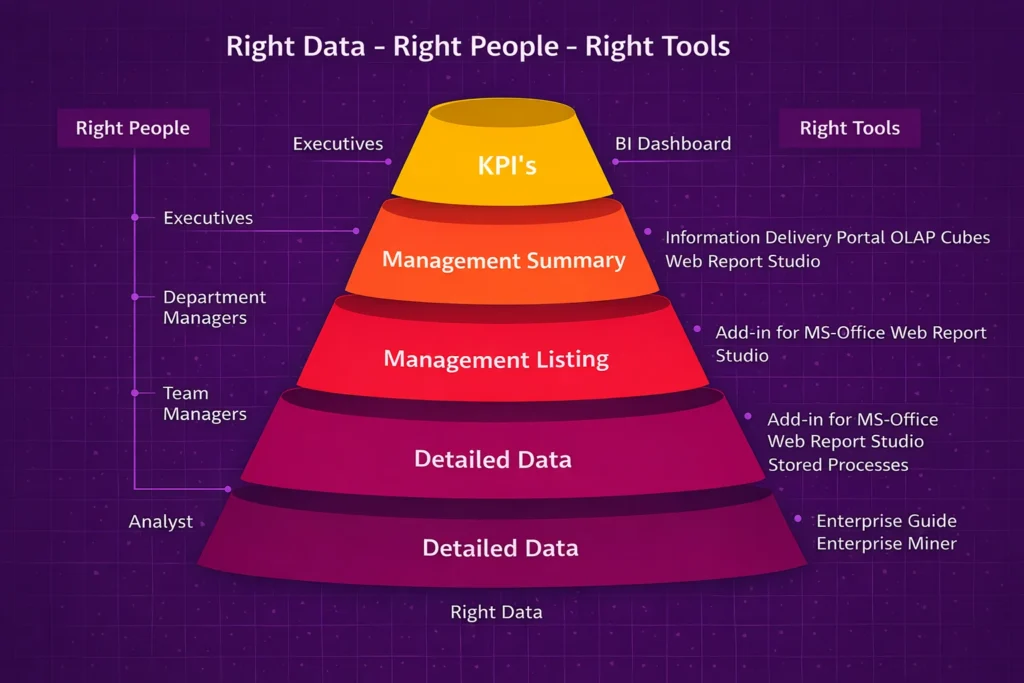
The 10 Steps of Developing BI Strategy
Step-by-Step Process to Build a BI Strategy
There are always different ways to reach your destination, here are the best steps to build a Bl strategy.
Step 1: Define Business Goals and Objectives
Every successful BI strategy starts with clear business goals. Without this foundation, data efforts become scattered and ineffective.
Instead of thinking about reports or tools, focus on the core questions the business needs to answer. For example, a company may want to increase revenue, reduce customer churn, or improve operational efficiency.
These goals guide everything that comes next. They ensure that your BI efforts are aligned with real business needs rather than technical curiosity.
Step 2: Identify Key Metrics and KPIs
Once the goals are clear, the next step is to define how success will be measured. Key Performance Indicators, or KPIs, translate business objectives into measurable values. The key here is relevance. Each metric should directly support a specific goal.
For example, a sales team may focus on revenue growth and conversion rates, while a marketing team may track customer acquisition cost and campaign performance. Operations teams often monitor efficiency and turnaround times.
It is better to focus on a small set of meaningful metrics rather than tracking everything. Too many KPIs reduce clarity and make decision-making harder.
Read More: Best Business Intelligence Tools
Step 3: Assess Your Current Data Landscape
Before building new systems, it is important to understand what data already exists within the organization.
This involves identifying data sources, evaluating data quality, and understanding how data flows between systems. In many organizations, data is spread across multiple platforms such as CRM systems, ERP systems, and spreadsheets.
During this assessment, common issues usually appear. Data may be inconsistent, duplicated, or stored in isolated systems that do not communicate with each other. Recognizing these challenges early helps in designing a more effective and realistic BI strategy.
Step 4: Define Data Governance and Standards
Data governance provides the rules and structure needed to manage data effectively. Without governance, data quickly becomes unreliable. Different teams may use different definitions for the same metric, or data may be updated inconsistently.
A strong governance framework clearly defines responsibilities and standards. This typically includes:
- Data ownership and accountability
- Data quality standards and validation rules
- Access control and security policies
Establishing these elements ensures that data remains accurate, consistent, and trustworthy across the organization.
Step 5: Choose the Right BI Tools and Technology
Technology plays an important role, but it should come after strategy. Once goals, metrics, and data requirements are clear, you can evaluate tools based on your needs. The right tool should integrate easily with your existing systems, be simple enough for users to adopt, and scale as your data grows.
Popular BI platforms such as Power BI, Tableau, and Looker offer strong capabilities, but the best choice depends on your specific context.
The key point is that tools should support your strategy, not shape it.
You can also read: How to Learn Power BI from Scratch in 12 Months
Step 6: Design Data Models and Architecture
At this stage, the focus shifts to structuring the data in a way that supports analysis. This usually involves creating a centralized data repository, often called a data warehouse, and building processes to move data from different sources into this system.
A well-designed data model ensures that relationships between data are clear and consistent. It also improves performance and makes it easier for users to explore and analyze information.
Even a simple and well-organized structure can significantly improve the effectiveness of your BI system.
Step 7: Build Dashboards and Reports
Dashboards are where users interact with data, so their design is critical. The goal of a dashboard is not to display as much data as possible. It is to answer specific business questions clearly and efficiently.
Effective dashboards focus on clarity and usability. They highlight key insights, use consistent metrics, and avoid unnecessary complexity.
When designed properly, dashboards become decision-making tools rather than just visual displays.
Step 8: Ensure Data Quality and Testing
Data quality directly impacts the credibility of your BI system. If users find errors or inconsistencies in reports, they will quickly lose trust and stop relying on them. This makes data validation a critical part of the strategy.
Common issues such as duplicate records, missing values, and incorrect data relationships need to be identified and resolved.
Regular testing and monitoring processes help maintain high data quality and ensure that insights remain reliable over time.
Step 9: Train Users and Drive Adoption
A BI strategy delivers value only when people use it effectively. Training is essential to help users understand how to read dashboards, interpret metrics, and apply insights in their daily work. It is also important to communicate the purpose of the BI system and how it supports business goals.
Building a data-driven culture takes time, but it is necessary for long-term success. When teams trust and rely on data, adoption becomes natural.
Step 10: Monitor, Optimize, and Scale
A BI strategy is not a one-time effort. It needs continuous improvement. As business needs evolve, new data sources may be added, and existing dashboards may require updates. User feedback plays a key role in identifying areas for improvement.
Over time, the BI system can expand across departments and support more advanced use cases. This gradual scaling ensures that the strategy remains effective and aligned with business growth.
Common Mistakes to Avoid
Many BI initiatives fail not because of lack of effort, but because of poor planning. One common mistake is starting with tools instead of defining business goals. Another is ignoring data quality, which leads to unreliable insights.
Organizations also tend to overcomplicate dashboards, making them difficult to use. In some cases, there is no clear ownership of data, which creates confusion and inconsistency.
Dig Deeper: Power Query vs Power BI
Final Thoughts
Building a business intelligence strategy requires more than technical implementation. It requires alignment between business goals, data, and people.
A step-by-step approach helps create a strong foundation and reduces the risk of failure. Instead of trying to do everything at once, it is more effective to start small, focus on key priorities, and improve gradually.
Over time, this approach leads to a system that not only reports data but also drives better decisions across the organization.
Check out our other blogs also Hasan the Analyst who can help make your business decisions & generate the revenue stream 5x times faster.
FAQs
What is a business intelligence strategy?
A business intelligence strategy is a structured plan that defines how an organization uses data to support decision-making and improve performance.
How long does it take to build a BI strategy?
The timeline depends on the size and complexity of the organization. Initial planning can take a few weeks, while full implementation may take several months.
What tools are used in business intelligence?
Common tools include Power BI, Tableau, and Looker. The choice depends on business requirements and existing infrastructure.
Do small businesses need a BI strategy?
Yes. Even a simple BI strategy can help small businesses make better decisions and operate more efficiently.
What is the difference between BI and data analytics?
Business intelligence focuses on reporting and monitoring performance, while data analytics involves deeper analysis and identifying patterns for future insights.