
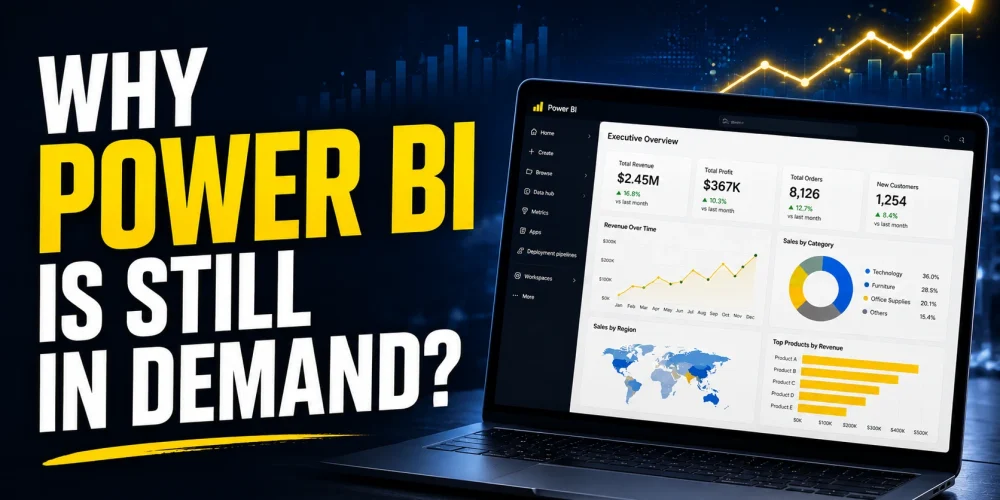
Businesses generate more data today than ever before. Every customer interaction, sales transaction, website visit, marketing campaign, and operational process creates valuable information. The challenge is no longer collecting data. The real challenge is turning that data into insights that support better decisions.
This is where Business Intelligence platforms play a critical role. Among the many tools available in the market, Power BI continues to hold a strong position. Despite growing competition from Tableau, Looker, Qlik, and various AI-powered analytics platforms, Power BI remains one of the most widely adopted business intelligence solutions worldwide.
Many professionals often ask questions such as: Is Power BI worth learning? What is the future of Power BI? How many days does it take to learn Power BI? The answers become much clearer when we look at why organizations continue to invest heavily in the platform.
The Growing Need for Data-Driven Decision Making
The demand for Power BI is closely tied to a larger business trend. Organizations are increasingly relying on data rather than intuition when making decisions.
Executives want real-time visibility into company performance. Marketing teams need campaign insights. Finance departments require accurate forecasting. Operations teams need performance monitoring. As data becomes central to business strategy, companies require tools that can transform raw information into meaningful visual reports.
Power BI addresses this need by making analytics accessible to both technical and non-technical users. Instead of depending entirely on IT teams, business users can explore data, build dashboards, and generate insights on their own.
Microsoft’s Ecosystem Creates a Major Advantage
One of the biggest reasons Power BI remains in demand is its integration with the Microsoft ecosystem.
Many organizations already use:
- Microsoft Excel
- Microsoft Teams
- Azure
- SharePoint
- SQL Server
- Microsoft Fabric
Power BI connects seamlessly with these platforms, creating a unified analytics environment. Companies that have already invested in Microsoft technologies often find Power BI to be the most practical and cost-effective choice.
Rather than introducing an entirely new analytics ecosystem, organizations can leverage existing infrastructure and user familiarity.
Cost Efficiency Continues to Attract Businesses
Budget remains an important factor when companies evaluate analytics solutions. Compared to many enterprise BI platforms, Power BI offers a lower entry cost while still providing advanced capabilities such as:
- Interactive dashboards
- Data modeling
- DAX calculations
- Real-time reporting
- AI-powered insights
- Cloud-based collaboration
For small and medium-sized businesses, this balance between functionality and affordability is particularly attractive.
Even large enterprises frequently choose Power BI because it allows them to scale analytics initiatives without significantly increasing software costs.
The Rise of Self-Service Business Intelligence
Traditional reporting processes often create bottlenecks. Business users submit requests, analysts build reports, and stakeholders wait for updates.
Modern organizations want faster access to information.
Power BI supports self-service business intelligence by enabling users to interact with data independently. Managers can filter reports, explore trends, and answer business questions without waiting for custom report development.
This capability reduces dependency on technical teams and accelerates decision-making. As companies continue to prioritize agility, the demand for self-service BI platforms remains strong.
Strong Demand in the Job Market
A practical way to evaluate the relevance of any technology is to examine hiring trends. Across industries, organizations continue to recruit:
- Power BI Developers
- Business Intelligence Analysts
- Data Analysts
- Reporting Specialists
- Analytics Consultants
- BI Architects
In many cases, Power BI appears as a required or preferred skill within these roles. The reason is simple. Organizations need professionals who can transform business data into actionable insights.
As long as companies rely on analytics for decision-making, Power BI demand will remain valuable in the job market.
Dig dive into: Data Analyst VS Business Analyst to learn what is the main difference between them to choose the right career path.
AI Is Strengthening Power BI Rather Than Replacing It
Some professionals worry that artificial intelligence will reduce the demand for traditional BI tools.
The reality is quite different. Microsoft has integrated AI capabilities into Power BI through features such as natural language queries, automated insights, and Copilot-powered analytics. Instead of replacing Power BI, AI is making the platform more powerful and easier to use.
Users can now generate insights faster, identify trends more efficiently, and interact with data using conversational prompts.
This evolution positions Power BI to remain relevant in an increasingly AI-driven business environment.
The Future of Power BI Looks Promising
When discussing the future of Power BI, it is important to consider Microsoft’s broader data strategy.
The introduction of Microsoft Fabric demonstrates Microsoft’s commitment to creating an end-to-end analytics ecosystem. Power BI serves as the visualization and reporting layer within this larger platform.
As organizations modernize their data infrastructure, Power BI is becoming more deeply integrated into enterprise analytics workflows.
Several trends support continued growth:
- Increased adoption of cloud analytics
- Expansion of Microsoft Fabric
- Growing use of AI-assisted reporting
- Rising demand for real-time dashboards
- Greater focus on data-driven decision making
These developments suggest that Power BI will continue to play a major role in business intelligence for years to come.
Is Power BI Still Relevant & Worth Learning?
For most aspiring analysts and business professionals, the answer is yes. Power BI offers a combination of strong market demand, practical business applications, and relatively accessible learning pathways. Unlike some specialized analytics tools, Power BI can be used across industries including finance, healthcare, retail, manufacturing, logistics, and marketing.
Learning Power BI also introduces concepts that are transferable to other analytics platforms, including data modeling, visualization design, reporting best practices, and business intelligence fundamentals.
For professionals seeking a career in analytics, Power BI remains one of the most valuable skills to acquire.
How Many Days to Learn Power BI?
The answer depends on your goals and prior experience. A beginner can usually learn the fundamentals of Power BI within two to four weeks of consistent practice. During this period, most learners can understand data connections, report creation, dashboard development, and basic visualizations.
Developing professional-level skills requires additional time, especially when learning:
- DAX
- Data modeling
- Power Query
- Performance optimization
- Advanced reporting techniques
Many professionals spend several months building practical expertise through real-world projects.
The good news is that Power BI has a relatively approachable learning curve compared to many enterprise analytics tools, making it accessible to a broad audience.
Final Thoughts
Power BI remains in demand because it addresses a fundamental business need: transforming data into actionable insights. Its integration with the Microsoft ecosystem, affordability, self-service capabilities, growing AI features, and strong job market demand continue to make it one of the most influential business intelligence platforms available today.
While technology will continue to evolve, the need for effective data analysis is not going away. Organizations still require tools that help them understand performance, identify opportunities, and make informed decisions.
For businesses, Power BI remains a practical analytics solution. For professionals, it continues to be a highly relevant skill with strong career potential. The combination of these factors explains why Power BI is still in demand and why its relevance is likely to continue well into the future.