
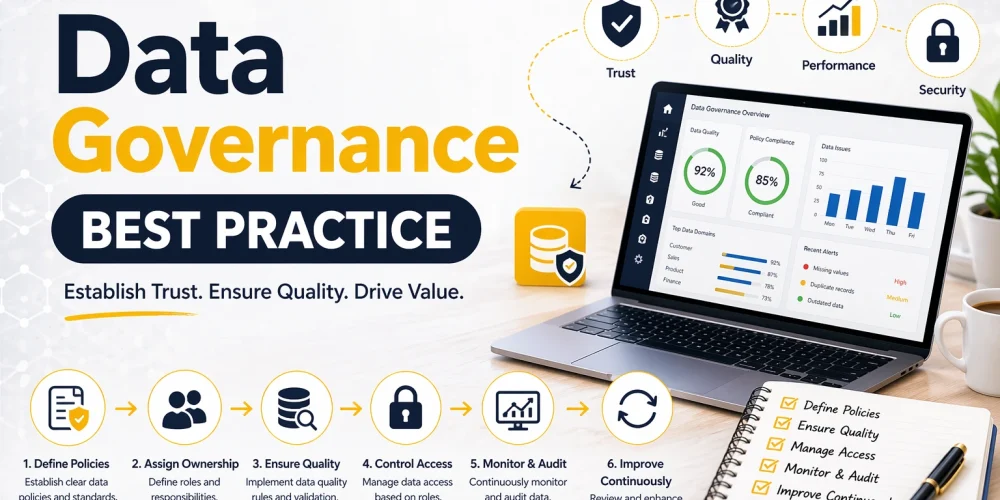
Data governance is one of those terms that sounds technical, but the idea behind it is very simple.
Every business relies on data. Sales numbers, customer records, financial reports, performance metrics. But as data grows, so does confusion. Different teams start using different versions of the same data. Definitions change. Numbers stop matching. Trust slowly disappears.
Data governance is the system that prevents that chaos.
It is a structured way of managing data so that it stays accurate, consistent, secure, and useful. It defines who owns the data, who can access it, how it should be used, and how it is maintained over time.
Think of it like a set of rules and responsibilities that keep data reliable across the entire organization. Without it, everyone works in their own way. With it, everyone works from the same foundation.
A simple example makes this clear. Imagine two teams reporting “customer count.” One includes inactive users, the other only active ones. Both believe they are right, but the numbers don’t match. Data governance ensures there is one clear definition that everyone follows. That is where consistency begins.
What Is Data Governance in Power BI
Power BI makes it incredibly easy to connect data, build dashboards, and share insights. That ease is powerful, but it also creates risk if there are no rules in place.
Data governance in Power BI is about managing how data is brought in, transformed, modeled, and shared within the platform so that everyone works with accurate and consistent information.
Without governance, it is common to see multiple reports showing different numbers for the same metric. This usually happens because different users pull data from different sources, apply their own calculations, or structure their models differently.
Governance in Power BI solves this by creating a controlled environment.
It ensures that reports are built on trusted data sources instead of scattered files. It encourages the use of shared datasets so teams are not rebuilding the same logic again and again. It defines who can access or modify reports, which prevents accidental changes or misuse. It also brings structure through organized workspaces and clear naming conventions, so users know exactly what they are working with.
When governance is done right in Power BI, the experience changes completely.
Why Data Governance Matters?
Most businesses only realize the importance of data governance after something goes wrong. A report shows incorrect numbers. Two teams present conflicting data. A decision is made based on incomplete information.
Data governance matters because it creates confidence in data. When people trust the numbers they are looking at, they make decisions faster and with more certainty. There is no need to double-check everything or question the source every time.
It also improves how teams work together. When everyone uses the same definitions and data sources, collaboration becomes smoother. There is less back-and-forth and fewer misunderstandings.
Another critical aspect is security. Not all data should be available to everyone. Governance ensures that sensitive information is protected and only accessible to the right people. This is especially important in areas like finance, healthcare, and customer data.
There is also an efficiency angle. Without governance, teams often duplicate work. Multiple versions of the same report get created, each slightly different. This wastes time and leads to confusion. Governance reduces that duplication by encouraging shared, standardized data models.
As businesses grow, this becomes even more important. More data, more users, more reports. Without governance, things break quickly. With governance, the system scales in a controlled and reliable way.
How Microsoft Fabric Supports Data Governance Strategies?
Data governance is about rules, responsibility, and trust. Microsoft Fabric is a technology platform. So why do they keep getting mentioned together?
Because in today’s data environment, governance is no longer just a policy. It needs a system to live in. And that is where Microsoft Fabric enters the picture.
Governance Needs a Place to Operate
In the past, data was scattered. Different tools for storage, different tools for reporting, different systems for processing. Governance in that setup was difficult to enforce because everything was disconnected.
Microsoft Fabric changes that.
It brings data engineering, data storage, analytics, and reporting into one unified environment. When your data lives in one place, applying governance becomes far more practical.
You are no longer chasing data across systems. You are managing it centrally.
Built-In Features That Support Governance
Microsoft Fabric is designed with governance in mind. It is not just about handling data, but about handling it properly.
For example, it allows organizations to control who can access data at a very detailed level. Permissions can be set across datasets, reports, and workspaces so sensitive information stays protected.
It also provides visibility into how data moves. With lineage tracking, you can see where data comes from, how it is transformed, and where it ends up. This level of transparency is critical for trust.
Another important aspect is integration with governance tools like Microsoft Purview. This helps with data cataloging, classification, and compliance, making governance more structured and easier to manage.
It Reduces Chaos in Large Data Environments
As organizations grow, so does their data. Without a unified platform, different teams start building their own systems. This leads to duplication, inconsistency, and confusion.
Microsoft Fabric helps reduce that chaos by creating a shared foundation.
Teams work within the same environment, use shared datasets, and follow the same structure. This naturally supports governance because there is less fragmentation.
It Turns Governance from Theory into Practice
Many organizations have governance policies documented somewhere. But policies alone do not solve problems.
What matters is execution.
Microsoft Fabric helps turn governance from something written into something applied. It provides the tools to enforce rules, monitor data usage, and maintain consistency without relying only on manual effort.
Governance Strategy
A strong data governance setup does not happen by accident. It follows a clear path. Without a strategy, governance turns into random rules that people ignore.
Here is a practical step-by-step approach that actually works:
1. Define Your Business Goals
Start with the reason behind governance. Are you trying to improve reporting accuracy, meet compliance requirements, or reduce data confusion across teams?
If the goal is not clear, governance becomes directionless.
2. Identify Critical Data
Not all data needs the same level of control. Focus first on the data that directly impacts decisions. Financial data, customer data, operational metrics. These should be your priority.
3. Assign Ownership
Every dataset must have a clear owner. Someone who is responsible for its accuracy and usage. Without ownership, accountability disappears, and issues remain unresolved.
4. Standardize Definitions
This is where most organizations struggle. Define key metrics clearly and make sure everyone uses the same meaning. A term like “revenue” or “active user” should never have multiple interpretations.
5. Set Access and Security Rules
Decide who can see what. Sensitive data should only be available to the right people. Set roles and permissions early to avoid misuse later.
6. Create Data Policies
Establish rules for how data should be collected, stored, transformed, and shared. These policies should be simple enough for teams to follow without confusion.
7. Implement Governance Tools
Use platforms like Power BI and Microsoft Fabric to enforce your rules. Features like role-based access, certified datasets, and data lineage help turn strategy into action.
8. Train Your Team
Governance fails when people do not understand it. Educate your team on why it matters and how to follow it. The goal is adoption, not enforcement.
9. Monitor and Improve
Data environments change constantly. Regularly review your governance practices, fix gaps, and improve over time. Governance is a continuous process, not a one-time setup.
Read More: How to Build a Business Intelligence Strategy
Key Components and Best Practices of Data Governance
This is where everything comes together. If governance is the system, There are parts that make it work. Let’s break it down in a way that actually helps you apply it.
1. Data Quality Management
If your data is wrong, nothing else matters. Good data quality means your data is accurate, complete, and consistent across systems.
Best practices:
- Validate data at the source instead of fixing it later
- Set rules to catch duplicates, missing values, and errors
- Monitor data regularly instead of checking it once
2. Data Ownership and Stewardship
Data without ownership quickly becomes unreliable.
Every dataset should have a data owner who is accountable a data steward who manages quality and usage
Best practices:
- Clearly define responsibilities for each role
- Avoid shared ownership without accountability
- Make owners visible so teams know who to contact
3. Data Security and Access Control
Not all data should be open to everyone. This is where governance protects the business.
Best practices:
- Use role-based access control instead of giving full access
- Limit sensitive data exposure (financial, personal, internal metrics)
- Regularly review who has access and remove unnecessary permissions
4. Data Standardization
Inconsistent data definitions are one of the biggest causes of confusion.
Best practices:
- Create a central glossary of key business terms
- Use the same naming conventions across reports and datasets
- Align metrics across all dashboards
5. Metadata Management
Metadata is simply data about your data. It tells you where data comes from, what it means, and how it is used.
Best practices:
- Document data sources and transformations
- Maintain clear descriptions for datasets and fields
- Keep metadata updated as systems evolve
6. Data Lineage Tracking
Data does not appear out of nowhere. It flows through systems. Lineage shows the full journey from source to final report.
Best practices:
- Track how data moves and transforms
- Use tools that visualize data flow (like in Power BI or Fabric)
- Use lineage to troubleshoot errors quickly
7. Use of Certified and Shared Datasets
One of the biggest mistakes in Power BI environments is duplication. Multiple people create the same dataset differently, leading to inconsistent reports.
Best practices:
- Create certified datasets as a single source of truth
- Encourage teams to reuse instead of rebuild
- Limit unnecessary dataset creation
8. Governance Through Simplicity
Overcomplicated governance fails. People stop following it.
Best practices:
- Keep rules simple and easy to understand
- Avoid unnecessary restrictions
- Focus on guidance rather than control
9. Continuous Monitoring and Improvement
Data environments never stay the same. Governance should not either.
Best practices:
- Regularly review data quality and access
- Update policies as business needs change
- Gather feedback from users and improve systems
Possible Challenges
Data governance sounds straightforward on paper, but in reality, most organizations struggle with it in the early stages.
One of the biggest challenges is resistance to change. People are used to working in their own way, and introducing rules can feel restrictive. If governance is seen as a barrier instead of support, adoption becomes difficult.
Another common issue is lack of clear ownership. When no one is responsible for data, problems go unnoticed or unresolved. This leads to inconsistent and unreliable information over time.
Data silos also create friction. Different departments store and manage their own data, making it hard to create a single, unified view. Without alignment, governance efforts remain incomplete.
There is also the challenge of overcomplication. Some organizations try to build perfect governance frameworks from the start. The result is a system so complex that no one follows it.
And finally, maintaining governance is an ongoing effort. Data keeps changing, systems evolve, and business needs shift. Without continuous monitoring, even a strong setup can weaken.
Roles and Responsibilities
Clear roles are the backbone of effective data governance. Without defined responsibilities, even the best strategy fails.
Here is how key roles are typically structured:
| Role | Responsibility |
| Data Owner | Accountable for the overall quality, accuracy, and usage of data. Makes key decisions related to the dataset |
| Data Steward | Manages day-to-day data quality, ensures standards are followed, and resolves data issues |
| Data Analyst | Uses data for reporting and insights while following governance rules and standards |
| IT Team | Handles infrastructure, data storage, security, and technical implementation of governance policies |
| Business Users | Consume data for decision-making and report any inconsistencies or issues |
| Governance Lead | Defines governance policies, ensures alignment with business goals, and oversees implementation |
When these roles are clearly defined, accountability becomes natural and governance starts to function smoothly.
How Most Organizations Deal with Data Governance
In reality, most organizations do not start with a perfect governance system. They evolve into it.
In the beginning, data is often unmanaged. Teams create their own reports, use different sources, and define metrics in their own way. It works for a while, but as the business grows, cracks start to appear. Reports don’t match. Decisions slow down. Trust in data drops.
This is usually the turning point.
Organizations then begin to introduce structure. It often starts small, with standardizing key metrics or creating a few trusted datasets. From there, they gradually define ownership, improve data quality, and set access controls.
Tools like Power BI and Microsoft Fabric are then used to support these efforts by centralizing data and enforcing rules.
The most successful organizations take a practical approach. They do not try to fix everything at once. Instead, they focus on high-impact areas, build governance step by step, and adjust as they grow.
Over time, governance becomes part of the culture rather than just a process. And that is when it truly starts delivering value.
Check out our power bi consulting services with Hasan the Analyst who can help make your business decisions & generate revenue stream 5x times faster.