
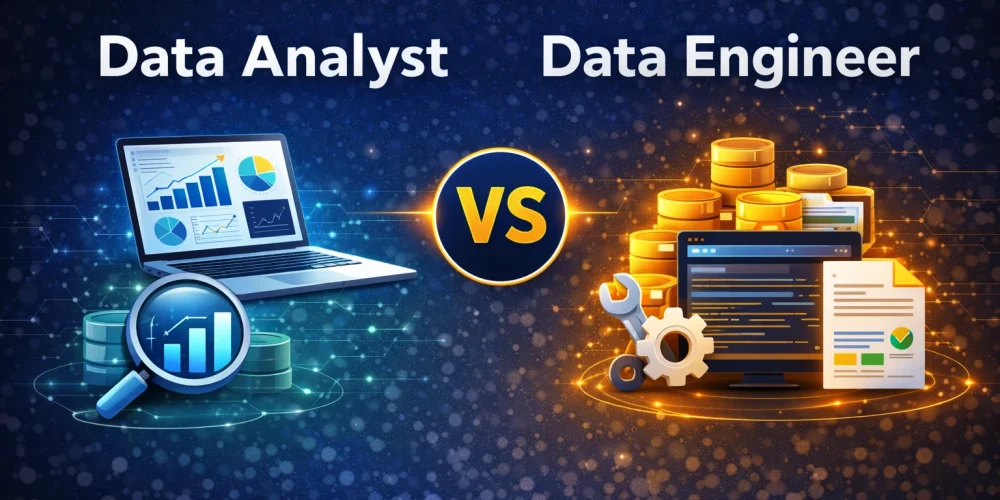
Many beginners get confused when they hear the terms data analyst and data engineer. Both roles work with data, both are in demand, and both sound quite similar at first. This often leads to a common question: are they the same job with different names, or are they completely different careers?
The truth is, these two roles serve very different purposes inside a company. Once you understand how they work in real situations, the difference becomes much clearer. This article breaks everything down in a simple and practical way so you can understand both roles without any confusion.
The Simple Difference
The easiest way to understand this is to focus on what each role produces. A data analyst works with data to generate insights that help businesses make decisions. A data engineer builds systems that collect, store, and prepare data so it can be used properly.
More simply, data engineers handle the foundation, and data analysts use that foundation to create value. If the data is not properly collected and organized, the analyst cannot do much with it. At the same time, if no one analyzes the data, the business gains nothing from it.
What Does a Data Analyst Actually Do
A data analyst focuses on turning raw data into meaningful insights. Their work is closely connected to business problems and decision-making.
In a typical scenario, a data analyst service provider might receive a dataset from a database or dashboard system. They clean the data, explore it, and try to identify patterns or trends. After that, they present their findings in a way that is easy for non-technical people to understand.
This often includes building dashboards, writing reports, or answering specific questions like why sales dropped last month or which marketing campaign performed best.
The role requires not only technical skills but also the ability to think logically and communicate clearly. A good analyst understands both the data and the business context behind it.
What Does a Data Engineer Actually Do
A data engineer works behind the scenes to make sure data is available, reliable, and structured properly. Their role is more technical and focused on systems rather than direct business questions.
They design and build data pipelines that move data from different sources into storage systems like data warehouses. These pipelines clean, transform, and organize the data so it can be used efficiently.
For example, a data engineer might create a system that collects data from a mobile app, processes it, and stores it in a database where analysts can access it later.
They also handle issues like data quality, system performance, and scalability. If data breaks or becomes inconsistent, it is usually the engineer who fixes the problem.
Key Differences Between Data Analyst and Data Engineer
A data analyst is focused on understanding data and generating insights. Their work is more business-oriented, and their output is usually dashboards, reports, or recommendations.
A data engineer is focused on building and maintaining systems. Their work is more technical, and their output includes pipelines, databases, and data architecture.
In terms of complexity, data engineering usually requires deeper programming knowledge and system design skills. Data analysis, on the other hand, requires strong thinking skills and the ability to interpret data correctly.
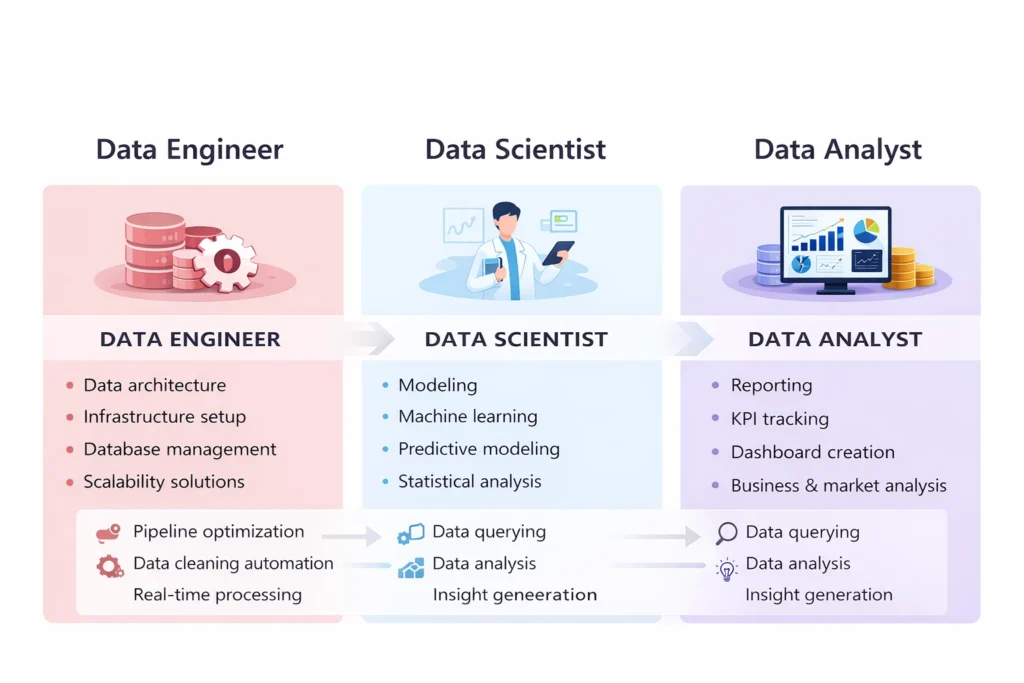
you can also Data Analyst VS Business Analyst who they are, what they do and decide which career path to choose.
Skills You Need for Each Role
The skill sets for these roles are different, although there is some overlap.
- For a data analyst, the most important skill is SQL. It is used to query data from databases. Excel is also widely used, especially for smaller datasets. Tools like Power BI or Tableau are important for creating dashboards and visualizations. Some analysts also use Python for data analysis, but it is not always required at the beginner level. Communication skills are also important because analysts often explain their findings to non-technical teams.
- For a data engineer, programming is essential. Python is commonly used, along with SQL at a more advanced level. Data engineers also work with tools like Apache Spark, Airflow, and cloud platforms such as AWS or Google Cloud. They need to understand how data flows through systems and how to design efficient pipelines.
Tools Used in Each Role
Data analysts typically use tools that help them explore and present data. This includes Excel, SQL databases, Power BI, Tableau, and sometimes Python libraries like Pandas.
Data engineers use more technical tools that focus on data processing and system management. Common tools include Apache Spark for large-scale data processing, Airflow for scheduling workflows, and cloud data platforms like BigQuery or Snowflake. They may also use Docker and other tools to manage environments.
The difference in tools reflects the nature of the work. Analysts focus on interpretation, while engineers focus on building and maintaining systems.
A Day in the Life: Data Engineer Vs Data Analyst
A data analyst’s day often involves querying data, cleaning datasets, and building reports or dashboards. They may also attend meetings with business teams to understand requirements or explain insights.
A data engineer’s day is more focused on maintaining and improving data systems. They might build new pipelines, fix broken data flows, optimize performance, or integrate new data sources into existing systems.
This difference in daily work shows how one role is closer to business decision-making, while the other is closer to backend development.
Salary Difference
In general, data engineers tend to earn more than data analysts. This is mainly because data engineering requires stronger programming skills and a deeper understanding of systems.
However, this does not mean data analysts are underpaid. Experienced analysts with strong domain knowledge and communication skills can also earn competitive salaries.
The salary gap is more noticeable at the entry level, where data engineering roles often require more technical preparation.
Which One Is Easier to Start
For most beginners, data analysis is easier to start. The learning curve is more manageable, and you can begin with tools like Excel and SQL without needing strong programming skills.
Data engineering has a higher entry barrier. It requires knowledge of programming, databases, and system design. This makes it more challenging for beginners, especially those without a technical background.
So, we can say both paths are achievable with consistent learning and practice.
Which Career Should You Choose
The right choice depends on your interests and strengths. If you enjoy working with data to find patterns, create reports, and help businesses make decisions, data analysis is a good fit. It is also a great starting point for entering the data field.
If you enjoy coding, building systems, and working on technical problems behind the scenes, data engineering may be a better choice. It offers deeper technical challenges and often higher long-term growth in engineering roles. There is no one-size-fits-all answer. The best option is the one that matches your skills and interests.
How They Work Together
In real-world projects, data analysts and data engineers work closely together. The engineer prepares the data by building pipelines and ensuring it is clean and accessible. The analyst then uses that data to generate insights and support decision-making.
If the data is not properly structured, the analyst cannot perform accurate analysis. If no one analyzes the data, the effort of building data systems does not create business value. This collaboration is what makes modern data-driven companies successful.
Final Thoughts
Data analyst and data engineer are two distinct roles with different responsibilities, skills, and goals. One focuses on understanding data, while the other focuses on building systems that make that understanding possible.
If you are just starting out, it is important to understand this difference clearly. It will help you choose the right learning path and avoid confusion later.
Both roles are valuable and in demand. The key is to choose the one that aligns with how you like to work and what kind of problems you enjoy solving.
Check out our other blogs also check out our services where we can help to make your business decisions & generate the revenue stream 5x times faster.
FAQs
1. Is data analyst easier than data engineer?
Yes, for most beginners, data analysis is easier to start because it requires less programming and system knowledge compared to data engineering.
2. Can a data analyst become a data engineer?
Yes, many professionals transition from data analysis to data engineering by learning programming, data pipelines, and system design.
3. Do data engineers need to know SQL?
Yes, SQL is essential for data engineers, often at a more advanced level than data analysts.
4. Which role has better career growth?
Both roles offer strong career growth, but data engineering often leads to more technical and higher-paying roles in the long run.