

Every business wants to grow, reduce costs, and make smarter decisions. But between data, stakeholders, technology, and strategy, things can get complicated fast. That’s where a business analyst comes in.
So, what does a business analyst do exactly?
A business analyst sits at the center of business and technology. They identify problems, analyze data, understand stakeholder needs, and help organizations implement solutions that actually make an impact. Business analysts play a key role in turning ideas into measurable results, it consists of improving internal processes, launching a new system, or optimizing performance.
What is the Role of a Business Analyst: Core Role in Modern Organizations
At its core, a business analyst helps organizations make better decisions by aligning business goals with data and technology. They do not just analyze numbers; they analyze business problems. A business analyst studies how a company operates, identifies gaps or inefficiencies, and recommends practical solutions that improve performance.
Their work typically involves understanding stakeholder needs, gathering and documenting requirements, analyzing data to uncover trends, improving workflows, and collaborating closely with IT teams, developers, and management. They ensure that proposed solutions are both technically feasible and aligned with strategic objectives.
For example, if a retail company wants to reduce inventory costs, a business analyst would examine sales patterns, detect inefficiencies in stock management, gather input from operations teams, and propose process or system improvements that lead to measurable savings.
Business Analyst Roles and Responsibilities
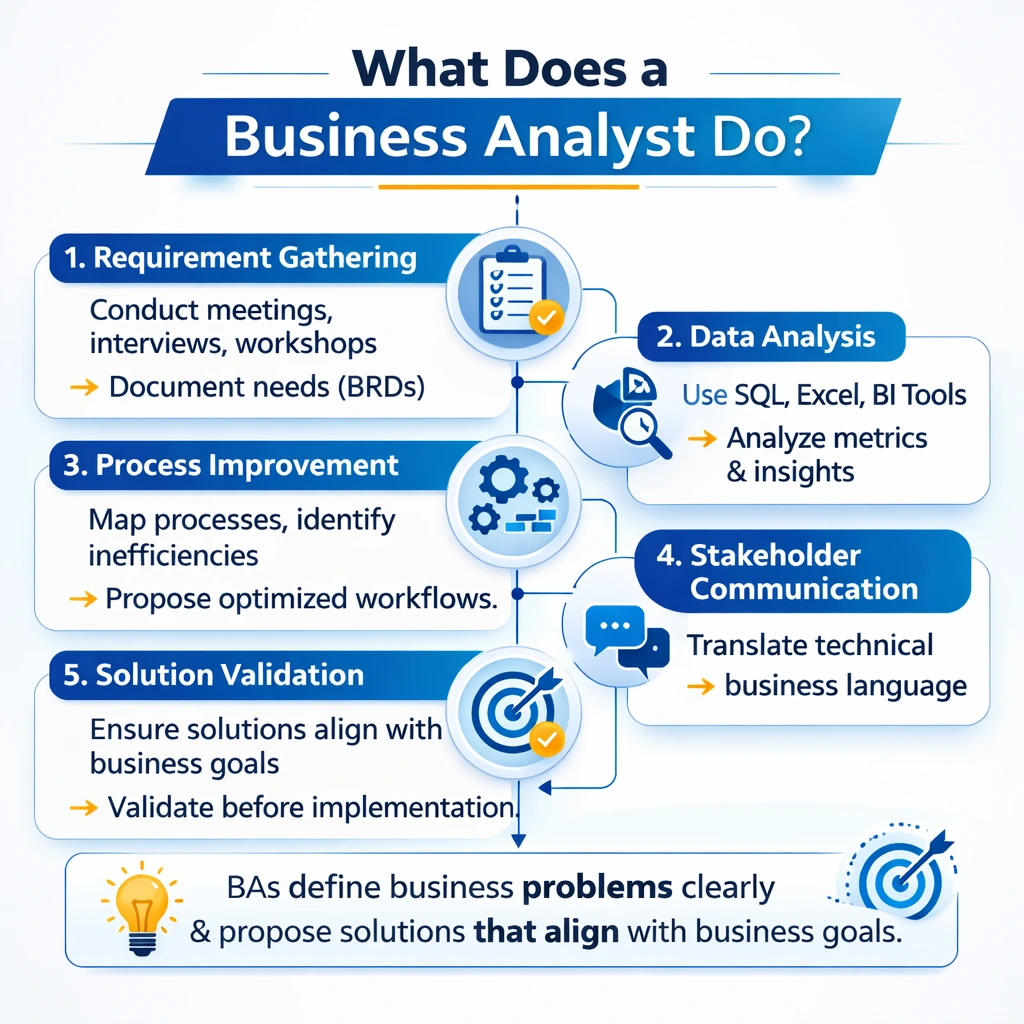
The roles and responsibilities of a business analyst vary by industry, but core duties usually include:
1. Requirement Gathering
Business analysts conduct meetings, interviews, and workshops to understand what stakeholders need. They document these in formats such as BRDs (Business Requirement Documents).
2. Data Analysis
Many business analysts use SQL, Excel, or BI tools to analyze performance metrics and uncover insights. Which leads to perfect decision through data analysis service.
3. Process Improvement
They map current processes, identify inefficiencies, and propose optimized workflows.
4. Stakeholder Communication
A key responsibility is translating technical information into business language and vice versa.
5. Solution Validation
Before implementation, business analysts ensure the proposed solution aligns with business goals.
In short, a BA ensures that business problems are clearly defined and properly solved.
Types of Business Analysts
There are different types of business analysts depending on the focus area:
- IT Business Analyst – Works closely with software development teams
- Data Business Analyst – Focuses heavily on data analysis and reporting
- Financial Business Analyst – Analyzes budgets, forecasts, and investments
- Product Business Analyst – Supports product development decisions
- Operations Business Analyst – Improves internal business processes
- AI Business Analyst – Works on AI-driven solutions and automation projects
The rise of AI has created new opportunities, especially for professionals who understand both business strategy and machine learning applications.
Skills Required to Become a Business Analyst
To build a successful career as a business analyst, you need a balanced mix of technical expertise and strong interpersonal abilities. This role sits on intersection of data, business strategy, and communication, so mastering both hard and soft skills is essential.
Technical Skills
Business analysts work closely with data, systems, and documentation. While the exact tools may vary by company, the following technical skills are commonly expected:
- Excel
- SQL
- Power BI or Tableau
- Basic data modeling
- Process mapping tools
- Documentation techniques
Although advanced programming is not mandatory, being comfortable with data tools and analytical platforms significantly increases your effectiveness and market value.
Soft Skills
Beyond technical knowledge, business analysts must interact with stakeholders, understand business challenges, and translate ideas into actionable solutions. That requires strong soft skills, including:
- Communication
- Critical thinking
- Problem-solving
- Stakeholder management
- Negotiation
In many cases, communication and stakeholder management skills are what truly distinguish an average business analyst from a high-impact professional.
Tools Used by Business Analysts
Business analysts use a mix of analytical and collaboration tools:
- Excel for data manipulation
- SQL for querying databases
- Power BI / Tableau for dashboards
- Jira/Clickup for project tracking
- Confluence for documentation
- Visio or Lucidchart for process mapping
Actually, tools they use for business analysis depend on the organization, but data literacy is becoming essential across all industries.
Read More: Data Science VS Data Engineering
Career Path of a Business Analyst
Career path of a business analyst is structured, scalable, and full of growth opportunities. As you gain experience, your responsibilities shift from supporting projects to leading strategic initiatives that influence business direction.
A typical progression looks like this:
- Junior Business Analyst
- Business Analyst
- Senior Business Analyst
- Lead or Principal Business Analyst
- Product Owner, Strategy Consultant, or Business Architect
At the junior level, the focus is usually on documentation and data support. As you move to mid and senior roles, you begin leading stakeholder discussions, managing complex requirements, and driving cross-functional projects.
Many experienced business analysts transition into product management, digital transformation leadership, or analytics-focused roles such as data strategy.
Certifications like ECBA, CBAP, or PMI-PBA can strengthen credibility. However, real-world problem-solving ability, communication skills, and business impact are what truly accelerate long-term career growth.
How Much Does a Business Analyst Make?
If you’re asking, how much does a business analyst make, the answer depends on experience and location.
Using United States as benchmark:
- Entry-Level: $65,000 – $85,000
- Mid-Level: $85,000 – $110,000
- Senior-Level: $110,000 – $140,000+
In countries like UK, Canada, and Australia, salary ranges are competitive and continue to grow due to increasing demand.
This salary range reflects the value business analysts bring in optimizing operations and supporting data-driven decision-making.
AI Business Analyst: Future of the Role
Artificial Intelligence is reshaping the business landscape, and business analysts are evolving with it. An AI business analyst focuses on identifying automation opportunities, working with predictive models, and translating AI-driven insights into clear business actions.
Rather than replacing analysts, AI enhances their decision-making capabilities. Professionals who understand both business strategy and emerging technologies will have a strong advantage in the future job market.
Is Business Analyst a Good Career in 2026?
Yes, business analysis remains a strong and growing career path in 2026. Employment of management analysts, a category that includes business analysts, is projected to grow 9 percent from 2024 to 2034, which is much faster than the average for all occupations. Around 98,100 openings are expected each year over the decade, driven by business expansion as well as workforce replacement.
Demand for BI consulting services continues to rise as organizations focus on improving efficiency and controlling costs in competitive markets. Growth is particularly strong in specialized consulting firms and government agencies seeking operational improvements. With steady demand, competitive salaries, and leadership pathways, business analysis offers long-term stability and career progression.
Final Thoughts
So, I hope you got the idea of what a business analyst does. They identify problems, analyze data, gather requirements, improve processes, and ensure solutions align with business goals. They are decision enablers who connect strategy, data, and technology.
With strong demand, competitive salary ranges, and evolving opportunities in AI, the career of a business analyst is both stable and future-ready.
If you’re building a career in analytics, developing business analysis skills could be one of the smartest moves you make in 2026.
Check out our other blogs also check out hasantheanalyst who can help to grow your business decion & revenue 5x times faster…